

Effective Email Follow-Up Strategies for Solo Ad Traffic to Maximize Conversions
Solo ad traffic can deliver real people to your offer, but only a conversion-focused email follow-up turns those clicks into customers. This article teaches how an effective solo ad autoresponder sequence works, why lead quality and landing page alignment matter, and the exact copy, cadence, and measurement tactics that drive predictable conversions. Readers will learn a step-by-step autoresponder setup, subject line and swipe templates, timing and sequencing best practices, and the key KPIs to test and optimize for higher opt-in and conversion rates. The guide covers crafting high-converting solo ad email swipes, designing multi-day follow-ups with segmentation, timing windows that maximize opens and clicks, and metrics-driven troubleshooting to fix low engagement. Throughout, we use semantic relations like autoresponder, landing page, opt-in rate, and conversion rate to link clinical measurement with practical tactics for solo ad traffic and email marketing.
How Do Solo Ads Generate Leads for Email Follow-Up?
Solo ads generate leads by placing a targeted promotional message in an established email list that drives recipients to an opt-in landing page, where the autoresponder captures contact data. This mechanism works because the seller’s list provides a pre-existing audience, the ad creates interest, and the landing page converts clicks into subscribers who enter an automated sequence. The specific benefit is predictable lead flow that scales with budget when offer alignment and list targeting are correct. Understanding this flow helps marketers design the landing page and autoresponder integration to maximize opt-in rates and downstream conversions. Below, we break down the core components that make the process reliable and measurable for email follow-up success.
What Is Solo Ad Traffic and How Does It Work?
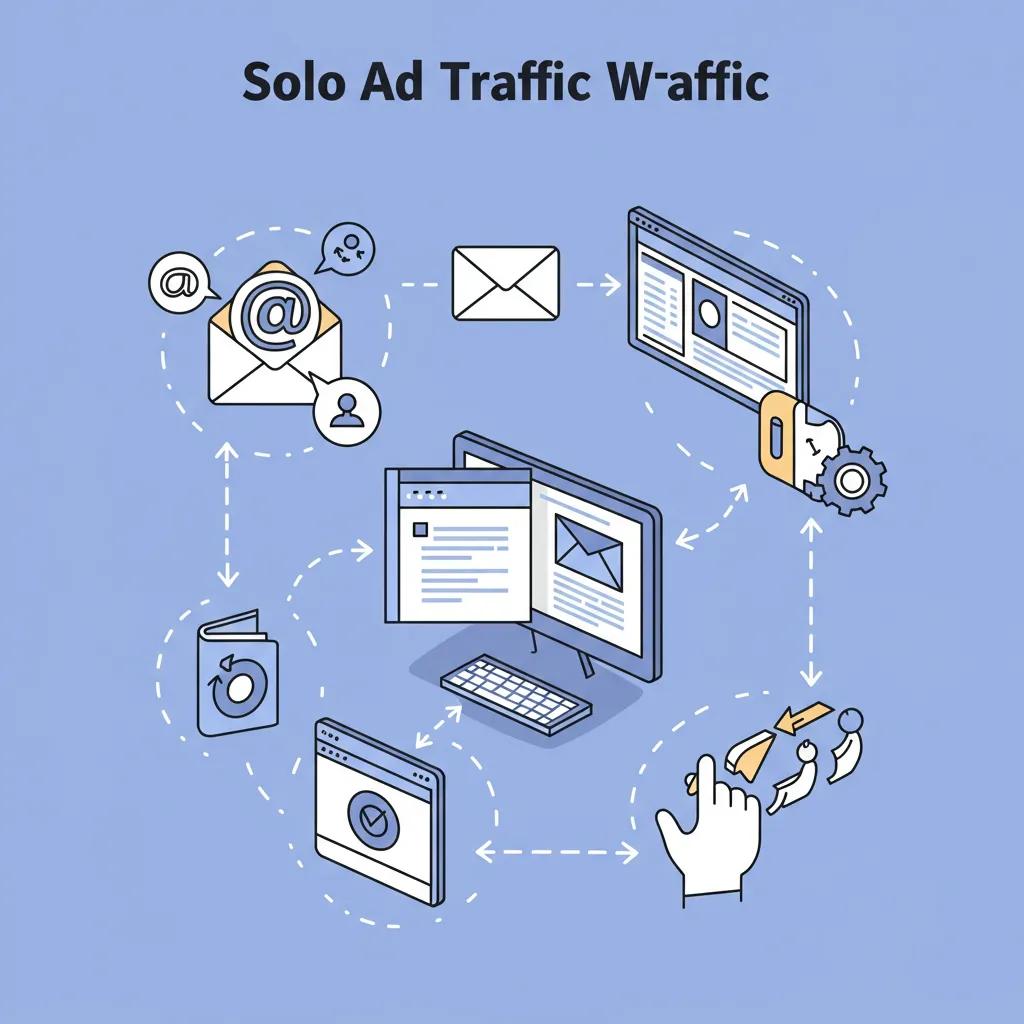
Solo ad traffic is paid email traffic where a list owner sends a promotional email on behalf of an advertiser and delivers clicks to the advertiser’s landing page. The mechanism typically follows three steps: the list owner emails their subscribers, interested recipients click through, and the landing page invites them to opt in and enter your autoresponder sequence. The value is that you buy access to a targeted audience without building the list yourself, which accelerates lead generation and testing. For effective execution, buyers must expect variability in open rates and clicks depending on list quality, niche targeting, and the relevance of the ad creative.
Why Is Real Human Traffic Crucial for Follow-Up Success?
Real human traffic matters because authentic opens, clicks, and opt-ins translate into genuine engagement that the autoresponder can nurture toward conversion. Bots or low-quality traffic inflate superficial metrics but damage deliverability, skew A/B tests, and waste funnel resources because non-human contacts won’t convert on offers or respond to segmentation. High-quality traffic yields higher opt-in rates and better long-term list health, improving subject-line testing and personalization effectiveness. For credibility, seek providers that verify human-only delivery and maintain niche targeting to protect deliverability and conversion forecasts.
How Do Landing Pages Impact Solo Ad Lead Capture?
Landing pages determine whether a click becomes a subscriber by aligning the ad promise with a clear opt-in proposition, fast load speed, and a low-friction form. The mechanism is simple: relevant headline + concise value proposition + visible form = higher opt-in rate; conversely, mismatch, slow loads, or confusing layouts reduce conversions. Testing headline variants, form length, and primary CTA placement typically produces measurable gains in opt-in rate within a few test cycles. Good landing pages also feed the autoresponder with source data via UTM parameters so subsequent follow-ups can be segmented by traffic origin.
Landing Page Optimization for Solo Ad Traffic
designed single-purpose landing pages that are not connected to your main website at all.
Landing page optimization: The definitive guide to testing and tuning for conversions, 2012
What Are Typical Opt-In Rates for Solo Ad Traffic?
Typical opt-in rates for quality solo ad traffic can range widely, but experienced sellers and buyers often see benchmarks in the mid-teens to low-thirties percent when offers and landing pages are well-aligned. Variability depends on niche, list health, ad creative, and landing page conversion optimization, with conservative expectations around 10–20% for many offers and 20–30% for tightly targeted, value-driven opt-ins. Understanding these benchmarks allows marketers to set realistic goals and allocate budget; if opt-in rates fall below expectations, the diagnosis should focus on landing page alignment, offer clarity, and list relevance. These benchmarks also determine the size of the autoresponder sequence and the expected volume of engaged leads.
For buyers who prioritize verified, human-only traffic, providers that advertise “100 percent Real Human Traffic Always” signal a reduced risk of bot-driven waste and a clearer path to effective follow-up sequences.
What Are the Best Practices for Crafting High-Converting Solo Ad Email Swipes?

A high-converting solo ad email swipe uses a compelling subject line, concise body copy that creates curiosity, and a single clear CTA that matches the landing page offer. The mechanism is to create a short bridge from the inbox to the landing page that preserves the promise made in the ad and minimizes friction between interest and opt-in. The specific benefit is higher click-through-to-opt-in ratios, which amplifies the return on purchased clicks and reduces cost per lead. Below we unpack subject lines, body techniques, CTAs, personalization, and provide example swipe templates you can adapt.
How Do You Write Subject Lines That Boost Open Rates?
Subject lines drive opens by promising value, creating curiosity, or invoking urgency while avoiding spammy words that hurt deliverability. The recommended approach is short, benefit-driven text (30–50 characters on mobile) that implies a clear payoff or curiosity gap and can be A/B tested quickly. Use personalization sparingly on rented list traffic; instead emphasize relevance and novelty such as “Quick tip for growing clicks today” or “The exact funnel that doubled conversions.” Test two variants per send and prioritize open-rate lifts before moving to CTR-focused tests; small subject-line wins cascade into better downstream performance.
Examples of subject lines to test:
- “One tweak that doubled my opt-ins”
- “Quick training: 3-step funnel that converts”
- “Limited spots — free case study”
- “How this simple page tripled clicks”
- “Free instant strategy for affiliates”
- “Why your solo ads aren’t converting”
These examples illustrate curiosity, benefit, and urgency variations that align with landing page promises and improve open rates when matched to the offer.
What Email Body Copy Techniques Drive Click-Throughs?
Effective body copy for solo ad emails is short, skimmable, and single-focused: quickly amplify the reader’s pain or desire, hint at the solution, and direct them to the landing page with one CTA. The mechanism uses short paragraphs, a curiosity opener, a brief social proof line or example, and a clear instruction to click the link or button. Keep sentences tight and avoid multiple competing CTAs; each email should track a single measurable action to simplify optimization. This structure increases CTR and improves the signal for A/B tests on creative and landing page alignment.
How Should You Design Effective Calls to Action in Solo Ad Emails?
Effective CTAs are benefit-focused, placed early and again near the close, and use tracking parameters so clicks are attributable to the campaign. The mechanism is to reduce decision friction by telling the reader exactly what happens when they click and what value they receive (e.g., “Get the free checklist” vs “Click here”). Use a short, bold link or button with matching landing page headline to create continuity and increase conversion probability. Track each CTA with unique UTM tags or tracking links to identify winning swipes and avoid diluting results across multiple CTAs.
How Can Personalization Improve Solo Ad Email Engagement?
Personalization increases relevance by connecting the email to what the recipient cares about, but with rented lists you should prioritize light personalization and behavioral triggers rather than heavy assumptions. The mechanism includes using first-name tokens when available, inserting a contextual line tied to the opt-in source, and triggering segmented flows based on clicks or landing page choices. Personalization improves open and click rates when accurate; however, incorrect or forced tokens reduce credibility, so validate data before relying on it for messaging decisions.
What Are Examples of Successful Solo Ad Email Swipes?
Concrete swipe templates give marketers ready-to-run copy for different objectives: curiosity-driven links, lead magnet promotion, and direct offer pushes. Each template contains a tested subject line, 2–4 short body sentences, and a single CTA, demonstrating how simplicity drives action. Use these templates as starting points and A/B test subject lines and CTA phrasing for your audience.
Templates include:
- Curiosity Template: short hook + single-sentence curiosity + CTA
- Lead Magnet Template: value proposition + bullet benefit + CTA
- Direct Offer Template: scarcity/benefit + strong CTA + social proof note
Testing these templates reveals which approach resonates with a given rented-list audience and informs sequence pacing and offer timing.
Below is a breakdown of swipe elements to guide copy construction.
| Swipe Element | Recommended Approach | Example / Guidance |
|---|---|---|
| Subject Line | Benefit or curiosity, 30–50 chars | “One tweak that doubled opt-ins” |
| Opening Line | Immediate relevance, 1–2 short sentences | “Struggling with low opt-ins? Try this…” |
| Body Copy | 2–3 short sentences, single idea | Explain value and link to landing page |
| CTA | Single, benefit-focused text | “Get the free checklist” |
| Link Placement | Primary link early + button at end | Use same UTM parameters on both |
How Do You Set Up an Autoresponder Sequence for Solo Ad Traffic?
An autoresponder sequence for solo ad traffic is an automated series of emails that moves new subscribers from awareness to conversion by delivering value, proof, and progressive offers. The mechanism combines immediate welcome messaging, sequential value emails, social proof and soft offers, followed by time-limited or direct sales messages, all triggered by the initial opt-in event. The specific benefit is predictable nurture that converts purchased clicks into buyers while enabling measurement of each step. Below we compare tools, provide a blueprint for a 5-7 email sequence, cover segmentation roles, and explain how to integrate landing pages with your autoresponder.
Which Autoresponder Tools Are Best for Solo Ad Campaigns?
Choose an autoresponder with strong deliverability, segmentation, and easy landing page integration to preserve list health and attribute conversions precisely. The mechanism that matters is SMTP reputation plus webhook/API support for instant tag application when a subscriber opts in. Select tools based on budget and feature needs: entry-level platforms for simple sequences, mid-tier for segmentation and automation, and advanced platforms for deliverability control. Use tools that allow easy export of reports and UTM-level tracking to connect email metrics to landing page conversions.
| Tool Category | Key Features | Best For |
|---|---|---|
| Entry-level | Simple automation, basic reports | Small tests and tight budgets |
| Mid-tier | Segmentation, A/B testing, webhooks | Growing lists needing segmentation |
| Advanced | Dedicated IP, deliverability tools | High-volume campaigns and accurate attribution |
How Do You Design a Multi-Day Follow-Up Email Sequence?
A 5-7 email sequence typically starts with an immediate welcome, continues with value and social proof, then introduces a soft offer before escalating to a direct pitch and re-engagement. Timing commonly uses immediate welcome, day 1 value, day 3 social proof, day 5 soft offer, day 7 hard offer, with re-engagement later if needed. Each email should have a single objective (build trust, prove value, or convert) and include tracking to measure which step produces the highest lift. Monitor open-to-click ratios per email and iterate copy and timing based on early performance data.
- Welcome: explain value and set expectations.
- Value 1: offer actionable advice relevant to the offer.
- Social proof: case studies or testimonials (truthful and concise).
- Soft offer: low-friction next step.
- Hard offer: scarcity or strong incentive.
- Re-engage: win-back sequence for non-responders.
What Role Does Segmentation Play in Autoresponder Automation?
Segmentation increases conversion probability by delivering more relevant follow-ups based on source, behavior, or stated interest. The mechanism uses tags applied at opt-in (source tag), behaviorally triggered flows (clicked link A vs B), and requalification segments (opened but didn’t click). Proper segmentation allows you to serve distinct messages—education for cold leads, product offers for engaged clickers—improving conversion rates and reducing unsubscribes. Implement a simple tag taxonomy and use it to route subscribers into tailored sequences that match their engagement patterns.
How Can You Integrate Landing Pages with Your Autoresponder?
Integrating landing pages ensures data flows into your autoresponder for immediate sequencing and attribution via webhooks, API, or HTML form posts. The mechanism is to capture UTM and source data at the form level, apply tags on opt-in, and redirect new subscribers to a thank-you page that triggers the first email. Use consistent UTM parameters on solo ad links and ensure the autoresponder records them to attribute conversions properly. Post-opt-in logic such as immediate redirect to a confirmation or resource page increases engagement and sets expectations for the upcoming sequence.
When you need help improving opt-in performance, consider providers that offer landing page assessment services to identify friction points and boost conversion. Combining quality solo ad traffic with landing page optimization increases the volume of qualified leads entering your autoresponder.
| Tool | Key Features | Best For |
|---|---|---|
| Basic Autoresponder | Simple flows, templates | New testers and small lists |
| Automation-focused | Advanced triggers, tagging | Segmented solo ad campaigns |
| Deliverability-first | Dedicated IP, analytics | High-volume, conversion-critical campaigns |
How Should You Time and Schedule Solo Ad Email Follow-Ups for Maximum Impact?
Timing and schedule determine whether your emails are seen and acted upon by subscribers coming from solo ads; immediate delivery plus a tested cadence improves response rates and conversion. The mechanism is to capture the hot interest window after opt-in with a fast welcome, then pace subsequent emails to build curiosity without overwhelming the new lead. The specific benefit is higher engagement and increased conversion probability when cadence aligns with recipient attention cycles. Below are actionable recommendations on number of follow-ups, best send times, email length, and the compounding benefit of consistent follow-up.
How Many Follow-Up Emails Should You Send After a Solo Ad?
A recommended range is 3–7 follow-ups, with five emails a common benchmark for non-routine sales where education and proof are needed. The mechanism is diminishing returns: early emails capture the most receptive responders, while later emails recover additional buyers with different objections or timing. Extend sequences for higher-ticket or longer-consideration offers, and stop emailing unsubscribed or long-inactive addresses to preserve deliverability. Track conversion per email to determine when to shorten or lengthen your sequence for a specific offer.
When Is the Best Time of Day and Week to Send Follow-Up Emails?
Best practice windows often show higher opens mid-morning (9–11am) and early afternoon, with mid-week days like Tuesday and Thursday frequently outperforming weekends for business niches. The mechanism relates to audience routines and mailbox competition; testing is essential because solo ad audiences may exhibit different behavior. Run timing A/B tests with subject line parity and monitor open and click lifts to determine the best slot for your specific audience. Prioritize mobile readability since many recipients open on mobile during commutes and short breaks.
How Does Email Length Affect Follow-Up Performance?
Short emails typically drive action in cold or affiliate-style sequences: concise 25–75 word messages with a single CTA outperform verbose copy for immediate clicks. Longer emails are beneficial for storytelling, case studies, or complex offers where building trust is required. The mechanism is cognitive load: short messages reduce friction and increase CTR, while longer messages allow persuasion and deeper context for higher-value offers. Test length against click-through rates and conversion outcomes for your niche.
What Are the Benefits of Consistent Follow-Up in Solo Ad Campaigns?
Consistent follow-up compounds conversions by converting different buyer mindsets over time and enabling segmentation based on engagement signals. The mechanism is repeated exposure: each email increases the chance a prospect will open, click, and eventually convert, while sequential messaging builds trust and demonstrates value. Over time, consistent sequences produce a higher lifetime value for the acquired list compared to one-off messages. Track cumulative conversion and revenue per campaign to quantify the compounding benefit.
How Do You Measure and Improve the Performance of Solo Ad Email Follow-Up?
Measurement requires tracking a small set of KPIs—open rate, click-through rate, opt-in rate, conversion rate, and deliverability metrics—and using those signals to prioritize tests that impact funnel performance. The mechanism is iterative: measure, hypothesize, test (subject line, CTA, timing, landing page), then implement the winning variation. The benefit is efficient improvement that increases ROI on purchased clicks and refines sequence effectiveness. Below we define key metrics, A/B testing best practices, conversion analysis, and common issues with remedies.
What Metrics Should You Track for Solo Ad Email Sequences?
Track the following metrics to diagnose performance and set optimization priorities: open rate, click-through rate (CTR), opt-in rate, conversion rate (sales or desired action), unsubscribe rate, and deliverability indicators. Each metric reveals a specific failure mode—low opens point to subject lines or deliverability, low CTR suggests body copy or CTA issues, and low conversion indicates landing page or offer problems. Benchmarks vary by niche and list quality, but improving the weakest metric first yields the fastest overall lift.
| Metric | Definition | Target / Benchmark |
|---|---|---|
| Open Rate | Percent of recipients who open the email | 15–30% (varies by list) |
| Click-Through Rate | Percent who click links in the email | 2–10% (depends on offer) |
| Opt-In Rate | Percent of clicks that opt in on landing page | 10–30% (quality traffic) |
| Conversion Rate | Percent of opt-ins who purchase | 1–10% (offer-dependent) |
How Can A/B Testing Improve Your Email Swipes and Sequences?
A/B testing isolates variables like subject lines, CTA phrasing, send times, and email length to determine what materially lifts opens and clicks. The mechanism is hypothesis-driven: change one element, run the test with a representative sample, and adopt the winner if statistically significant. Prioritize subject lines and CTAs because they most directly affect opens and clicks; sequence-level tests can then optimize timing and offer placement. Maintain test discipline by running single-variable experiments and documenting results to build a repeatable optimization playbook.
How Do You Analyze Conversion Data from Solo Ad Traffic?
Analyze conversion data by connecting UTM-tagged solo ad links to landing page metrics and autoresponder reports to attribute sales across sequence steps. The mechanism is to use consistent tracking parameters on ad links, capture them on opt-in, and report conversion events back to the autoresponder or analytics platform. Evaluate conversion by source, email number, and segmentation to identify which steps drive sales and which require fixes. When conversion is low, trace back to CTR and landing page performance to isolate the bottleneck.
What Are Common Issues in Low Email Engagement and How to Fix Them?
Low engagement typically stems from deliverability problems, weak subject lines, misaligned landing pages, or poor list quality; each has specific remedies. The mechanism of fixing is diagnosis: check bounce and complaint rates for deliverability, run subject-line A/B tests for opens, simplify landing page forms for opt-in rate, and validate traffic quality for list issues. Re-engagement campaigns and list cleaning improve long-term deliverability while iterative copy testing restores engagement metrics for active subscribers.
What Are Effective Lead Nurturing Techniques for Solo Ad Traffic?
Lead nurturing for solo ad traffic layers value content, segmentation, and behavioral triggers to build trust before pushing offers, which increases conversion probability relative to immediate hard sells. The mechanism is progressive profiling and value-first messaging that positions the offer as a natural next step. The benefit is higher conversion rates from purchased leads and better list health that supports future campaigns. Below we describe sequence progression, personalization roles, and segmentation tactics that lift conversion.
How Does an Email Follow-Up Sequence Nurture Solo Ad Leads?
An effective follow-up sequence moves from welcome and instant value to credibility-building and then to offers that match the lead’s readiness. The mechanism is staged persuasion: welcome sets expectations, educational emails demonstrate competence, social proof reduces risk, and offers provide a clear next step. Use content types such as short tutorials, case studies, and micro-commitments to warm leads. Measure nurture effectiveness by tracking engagement curves and conversion uplift for leads that receive the full sequence versus those who see only initial messages.
What Role Does Personalization Play in Lead Nurturing?
Personalization increases perceived relevance and motivates action when based on accurate tokens or behavior. For solo ad leads, practical personalization uses the opt-in source, clicked links, or form responses rather than speculative demographic data. The mechanism is to use tags and dynamic content to adjust messaging, such as offering different follow-ups to users who clicked a training link versus those who clicked a pricing link. Keep personalization light and tested to avoid errors that reduce trust.
How Can Segmentation Increase Lead Conversion Rates?
Segmentation raises conversion by grouping leads into flows tailored to intent, engagement, or source, enabling targeted offers that resonate with each segment. The mechanism includes initial segmentation at opt-in (source tag), engagement-based segmentation (clicked vs not clicked), and offer-specific segments (lead magnet chosen). Map 3–4 segments—new subscribers, engaged clickers, near-converters, and inactive—to specific flows with tailored CTAs to maximize conversion probability across the list. Proper segmentation turns a one-size-fits-all sequence into multiple optimized pathways.
What Are Common Questions About Solo Ad Email Follow-Up?
This section provides concise, actionable answers to frequently asked operational questions about autoresponders, swipe construction, opt-in optimization, and sequence length. The mechanism is to remove ambiguity and give quick reference guidance so marketers can implement and test follow-up strategies with rented-list traffic. The benefit is faster troubleshooting and clearer A/B testing priorities when running solo ad campaigns.
How Do Autoresponders Work with Solo Ads?
Autoresponders capture opt-ins from the landing page and trigger predefined sequences, tagging subscribers based on source and behavior for subsequent flows. The mechanism is form submission → API/webhook → tag application → immediate welcome email and scheduled follow-ups. This workflow ensures new leads receive timely messages and that clicks are tracked for attribution and segmentation. Implementing clear tags at the point of opt-in enables precise routing and performance analysis across the campaign lifecycle.
What Makes a Good Solo Ad Email Swipe?
A winning swipe aligns subject, short body, and single CTA to the landing page, preserves the ad promise, and minimizes friction to drive clicks. The mechanism is consistency: the inbox message, link, and landing page headline must all promise the same outcome so recipients complete the opt-in action. Key checklist items include a benefit-driven subject, 2–3 short body sentences, one clear CTA, and tracking parameters to measure performance. Use continuity across assets to reduce drop-off between click and opt-in.
Checklist for a strong swipe:
- Subject matches offer and evokes curiosity.
- Body copy is concise and single-focused.
- CTA is benefit-oriented and matches landing page.
- Tracking parameters are applied for attribution.
How Do You Optimize Opt-In Rates for Solo Ad Traffic?
Optimize opt-in rates by matching ad copy to landing page, simplifying forms, offering relevant lead magnets, and including social proof to reduce perceived risk. The mechanism is to reduce friction and increase perceived value at the exact moment of decision. Run A/B tests on headline, form fields, and button text, and test lead magnet relevance to the ad’s promise. Use heatmaps and load-speed analysis to catch technical issues that silently reduce conversions.
Conversion Marketing: Building Your Email Newsletter
building your email newsletter
Conversion marketing: convert website visitors to buyers, 2014
How Many Follow-Up Emails Are Recommended?
Three to seven follow-up emails are typical, with five serving as a practical benchmark for most non-routine offers; extend or compress based on offer complexity and engagement signals. The mechanism is balancing persistence with respect for subscriber inboxes: enough touches to convert undecided buyers without causing complaints. Include unsubscribe and suppression rules, and remove long-term inactive subscribers to preserve deliverability. A standard cadence example is immediate welcome, day 1 value, day 3 social proof, day 5 soft offer, and day 7 hard offer.
When Should You Send Follow-Up Emails After a Solo Ad?
Send the welcome email immediately after opt-in to capture attention and set expectations, then space follow-ups at 24–72 hour intervals depending on how quickly you need conversions and the audience’s engagement patterns. The mechanism is to capture the hot interest window with immediacy and then steadily build value without overwhelming recipients. Adjust cadence if engagement signals indicate faster or slower responsiveness; use time-based triggers or behavior-based flows for best results.
For marketers ready to evaluate their solo ad funnel, consider reviewing the traffic source, landing page conversion, and autoresponder sequence together. Combining high-quality solo ad traffic with landing page assessment services improves opt-in volume and conversion consistency, and providers that offer guaranteed human traffic and landing page assessments reduce execution risk and speed up results. Wholesale Premium Traffic emphasizes 100 percent Real Human Traffic Always and offers landing page assessment options and traffic packages with a risk-free guarantee to help advertisers focus on scaling sequences that convert.