
Boost Conversions with Smart Landing Page Optimization Tips
How to Increase Conversion Rates with High-Converting Design and Testing
Landing page optimization is the practice of refining a single web page to increase the percentage of visitors who take a desired action, improving conversion rate and ultimately driving better ROI. This guide explains why conversion-focused design matters, how testing and analytics reveal what works, and which elements consistently lift performance for email-driven traffic such as solo ads. Many marketers struggle to interpret noisy traffic signals or to align headlines, offers, and forms to the intent in an incoming email click, which reduces conversion rate and wastes ad spend. This article lays out the key elements of a high-converting landing page, mobile and speed optimizations, solo-ad-specific best practices for Make Money Online offers, an A/B testing framework, essential analytics to track, and how to get an expert assessment. By the end you will have actionable checklists, prioritized tests, and metric-mapped recommendations to increase landing page conversions and make traffic investments more efficient.
What Are the Key Elements of a High-Converting Landing Page?
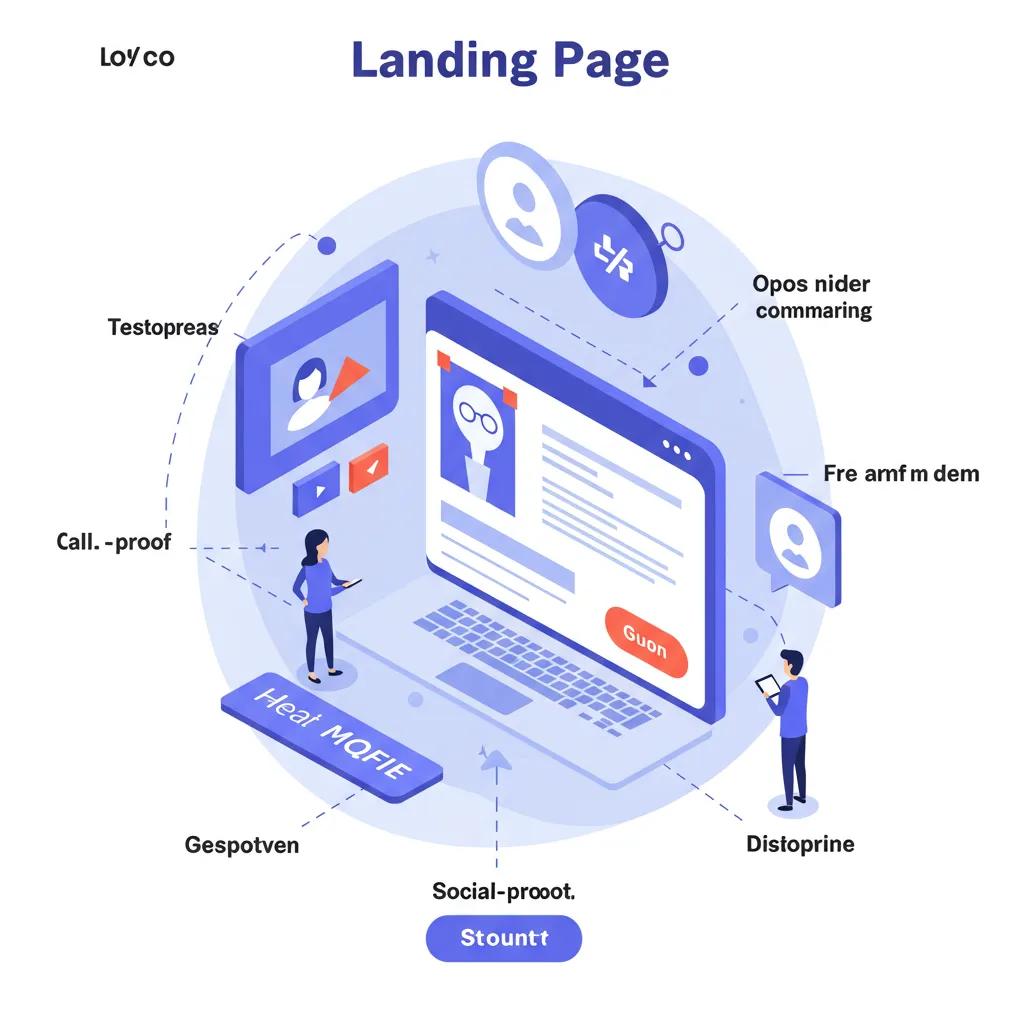
A high-converting landing page clearly communicates a single, compelling value proposition and removes friction so visitors complete the intended action; it works because clarity reduces cognitive load and builds immediate trust, which increases clicks and form submissions. These pages focus on message match with traffic source, a visible above-the-fold goal, and persuasive elements that align with user intent. Below are the core elements that routinely determine conversion performance and why each matters for email-driven traffic.
The essential components include:
- A benefit-driven headline that states the primary result the visitor will get.
- A concise subheadline that clarifies the headline and sets expectations.
- A clear single-call-to-action (CTA) with visible placement and active wording.
- Social proof such as testimonials, usage stats, or endorsements to increase trust.
- A minimal lead capture form that asks only for essential fields and reduces friction.
These elements form the baseline for conversion rate optimization techniques and landing page design tips that prioritize user intent and measurable outcomes. Understanding these parts leads naturally to a quick comparison of how to implement each element in practice.
| Element | Purpose | Best Practice |
|---|---|---|
| Headline | Capture attention and communicate core benefit | Use clarity-over-cleverness; state the primary outcome in one line |
| Hero section | Support headline with visual hierarchy and CTA | Place CTA in the hero with directional cues and a short supporting sentence |
| CTA | Drive the action with clear intent | Use action verbs, contrast color, and single-goal focus above the fold |
| Social proof | Reduce perceived risk and build credibility | Use short testimonials, numbers, or badges relevant to the niche |
| Lead capture form | Collect necessary data while minimizing friction | Limit fields, use inline labels, and show privacy/reassurance copy |
This table gives a quick reference to prioritize changes that typically deliver the biggest lifts while keeping the landing page focused on a single conversion goal. The next subsections detail headline/CTA mechanics and social proof placement to help you implement these practices effectively.
How Do Headlines and Calls to Action Drive User Engagement?
A headline and CTA form the core persuasion loop: the headline promises a benefit and the CTA tells the visitor what to do next, and together they guide attention and action. Headlines should follow the rule of clarity first—explicitly state who the offer is for and what result it will get—because readers scanning an email click want immediate confirmation that the landing page matches the message. Effective CTAs use strong verbs, imply immediacy or value, and appear in high-contrast design elements to be thumb-tap friendly on mobile. Directional cues such as arrows or brief explanatory microcopy near the CTA improve engagement by reducing uncertainty about the next step. Testing headline variants and CTA wording is a high-impact, low-cost first experiment to increase click-to-conversion rates.
These headline and CTA choices set up the need for social proof, which is the next critical element to address for credibility and reduced friction.
Why Is Social Proof and Clear Value Proposition Essential?
Social proof and a concise value proposition convert skeptical clicks into confident actions by demonstrating that others have benefitted and by clarifying the page’s unique benefit in a single sentence. Use social proof formats that match your audience: short testimonials for Bizopp offers, conversion stats for CPA funnels, or known-entity endorsements for Clickbank products; relevance increases believability. A one-line value proposition follows a simple template: who + benefit + differentiation, for example, “Aspiring affiliates get proven email swipe templates that increase opt-ins with minimal setup.” Place proof near the CTA and in the hero to reinforce the message just as visitors decide to act. Sourcing credible proof—real numbers, succinct quotes, or verifiable third-party metrics—amplifies trust and lowers perceived risk before the form.
These trust signals lead into mobile and performance priorities, because proof and CTA must render quickly and clearly across devices.
How Can You Optimize Landing Pages for Mobile Traffic and Speed?

Mobile optimization and page speed are technical and UX priorities that directly affect landing page conversion rate, because slower or cluttered mobile pages increase abandonment and reduce engagement. Optimizing for mobile-first layouts and minimizing asset weight improves perceived performance and keeps the CTA reachable by thumb, which is essential for email-driven solo ad clicks. Page load speed operates as both a UX and an SEO signal; targeting a sub-3-second load provides a reasonable threshold for reducing bounce and improving measured conversions on modern mobile networks.
To implement mobile-first and speed improvements, start with a short checklist that targets layout, assets, and scripts.
- Prioritize a single-column flow with thumb-friendly CTA placement.
- Compress and serve responsive images; use modern formats and lazy-loading.
- Limit third-party scripts and defer non-critical JavaScript to reduce main-thread blocking.
- Use browser caching, gzip/ Brotli compression, and a minimal CSS footprint to improve first paint.
These practical steps reduce friction and create a mobile experience that sustains attention from an incoming email click to conversion. The following brief table maps mobile best practices to specific implementation actions.
| Best Practice | Technique | Measurable Target |
|---|---|---|
| Mobile-first layout | Single-column hero, large CTA | CTA visible without scrolling on common devices |
| Image optimization | Responsive srcset, modern formats | Reduce image bytes by 50%+ while retaining clarity |
| Script management | Defer analytics and non-essential widgets | Improve Time to Interactive by 20-40% |
| Compression & caching | Enable Brotli/gzip and cache headers | Target full load ≤ 3 seconds on 3G/4G tests |
Applying these optimizations reduces abandonment and creates a reliable baseline for A/B testing, which ensures that conversion gains come from content and design rather than transient performance issues.
What Are Best Practices for Mobile-First Landing Page Design?
Mobile-first landing page design focuses on a streamlined experience where the primary CTA and key message appear immediately, because visitors from email clicks expect an instant match and a quick path to action. Use a single-column layout to control reading order, minimize form fields to reduce touch interactions, and make CTAs large with ample spacing to prevent mis-taps. Progressive disclosure—ask only for essential information up front and collect additional details later—reduces initial friction and increases completion rates. Visual hierarchy should emphasize the headline, a short value sentence, and the CTA; decorative elements and long social proof blocks should be deferred below the fold.
These UX choices reduce cognitive load and improve conversion metrics, and they also lower variability in A/B tests by ensuring consistent user experiences across devices.
How Does Page Load Speed Affect Conversion Rates?
Page load speed strongly correlates with conversion rate because each additional second of load increases the probability of abandonment; current research shows a significant portion of mobile users abandon pages that take longer than about three seconds to load. Faster pages not only keep users engaged but also produce cleaner A/B test data because performance-related drop-off is removed as a confounding factor. Immediate fixes with high impact include image compression, server-side caching, critical CSS inlining, and reducing render-blocking JavaScript. Use Lighthouse or WebPageTest to identify and prioritize issues, and monitor metrics such as First Contentful Paint (FCP) and Time to Interactive (TTI) after each change.
Addressing speed creates a stable foundation so that subsequent design and copy experiments reflect true user preferences instead of technical friction.
What Are the Best Landing Page Optimization Practices for Solo Ads Traffic?
Optimizing landing pages for solo ads means aligning message match, load speed, and offer clarity with the intent embedded in an email click; solo-ad traffic is email-driven, often with high intent but variable list quality, so landing pages must confirm the offer immediately and limit distractions. Best practices emphasize headline alignment with the email creative, a single conversion funnel, and social proof that resonates with Make Money Online audiences. Segmented landing pages by offer type—Bizopp, Clickbank, CPA—improve relevance and conversion because each vertical responds to different hooks and credibility signals.
Below is a prioritized checklist of solo-ads-specific optimizations to implement before scaling traffic.
- Ensure message match between the solo ad copy and landing page headline and hero.
- Use a single above-the-fold CTA that mirrors the email’s call to action.
- Keep load times low and forms minimal to honor the email clickers’ intent.
- Include niche-specific social proof and quick trust cues tailored to MMO offers.
- Segment pages by offer type and maintain separate analytics for each segment.
This checklist helps you convert email clicks into measurable leads and sales while keeping tests interpretable and results actionable. High-quality traffic amplifies these benefits, which is why a clean assessment and premium traffic improve outcomes when used together.
Wholesale Premium Traffic supplements these optimization steps by offering high-quality solo ads and a landing page assessment that benchmarks your page against best practices. Their service emphasizes 100 percent real human traffic, a risk-free guarantee allowing order cancellation before delivery, and campaign features such as fast delivery windows and a 10 percent over-delivery policy. Combining a prioritized page assessment with fresh, human email traffic reduces noise in A/B tests and accelerates reliable conversion lifts for Make Money Online campaigns.
How Does High-Quality Solo Ad Traffic Influence Landing Page Success?
High-quality solo ad traffic changes the signal-to-noise ratio for landing page performance because human, intent-driven clicks produce more reliable conversion data than bot-laden or low-quality lists. When traffic quality is high, conversion benchmarks can be trusted and A/B tests reach significance faster, enabling iteration and scale. Conversely, low-quality clicks inflate bounce rates and produce misleading test outcomes that waste optimization effort. Therefore, validate traffic source quality and segment performance by list origin and creative to interpret results and prioritize fixes.
Understanding traffic quality leads to targeted features that maximize conversions for MMO offers, discussed next.
What Landing Page Features Maximize Conversions for Make Money Online Offers?
Certain landing page features consistently improve conversions in the Make Money Online niche: clear benefit-led headlines, short social proof bites, minimal opt-in fields, and risk-reduction statements that lower purchase anxiety. Include headline templates focused on outcome, place testimonials near the CTA for immediate credibility, and use privacy or guarantee language that addresses common MMO objections. For offers that require deeper trust, provide a concise FAQ below the fold but avoid diluting the above-the-fold CTA.
- Headline template: “[Result] for [Audience] in [Timeframe] — No [Pain Point]”
- Social proof placement: within hero and near form
- Form fields: email and one optional field; defer upsells until after initial conversion
These features create a persuasive yet friction-light experience that respects the intent generated by an email click and improves both conversion rate and test validity.
How Do You Use A/B Testing to Improve Landing Page Conversion Rates?
A/B testing is the scientific method for landing page optimization: define a hypothesis, test a single variable, measure a primary metric, and implement winners; this process works because it isolates cause-and-effect and produces data-driven decisions. Start each experiment with a clear hypothesis tied to expected impact and required sample size, run tests long enough to avoid temporal bias, and segment results by traffic source and device to ensure applicability. Prioritize tests by expected impact and ease of implementation to increase the rate of meaningful improvements.
Below is a prioritized A/B test plan table you can implement immediately to get fast wins.
| Element to Test | Hypothesis | Expected Impact / Sample Metric |
|---|---|---|
| Headline | Clear benefit headline increases relevance | +10–30% conversion rate lift on headline variants |
| CTA text & color | Stronger verb + contrast improves clicks | +5–20% CTA click-through |
| Form length | Fewer fields reduce friction | +15–40% form completion |
| Hero image | Relevant imagery increases trust | +5–15% engagement |
| Social proof placement | Proof near CTA reduces hesitation | +5–20% conversion uplift |
This prioritized list helps focus testing on high-impact elements that typically move the needle with realistic sample sizes and expected effects. The next subsections explain which elements to test first and how to analyze results to avoid common pitfalls.
Which Landing Page Elements Should You Test First?
Start with the elements that have the highest expected impact for lowest implementation cost: headline, CTA wording/color/placement, and form length. Headline and CTA tests require minimal development and can produce rapid insights, while form redesigns require slightly larger changes but yield measurable payoffs. When traffic volume is limited, test high-impact elements sequentially and use pre-test power calculations to estimate the required sample size. Document each test’s hypothesis and expected uplift, and include segmentation by traffic source—especially for solo ads—to detect interactions between message match and creative.
Prioritizing these tests ensures early wins and creates a structured backlog for continuous improvement.
How Do You Analyze and Apply A/B Test Results Effectively?
Analyze tests by first confirming statistical significance without peeking bias, then validating that the result is consistent across key segments such as mobile vs desktop and by traffic source. Use a significance threshold appropriate to your risk tolerance and traffic volume, and avoid acting on small short-term swings that fall below your pre-defined confidence level. After declaring a winner, implement the change sitewide or to the relevant segment, then plan follow-up experiments to iterate on the improvement. Keep a documented test log that records hypotheses, dates, and metrics so future decisions build on institutional knowledge.
Applying winners methodically produces compounding gains and prevents regression by ensuring each change is verified across the audience.
What Metrics and Analytics Are Essential for Landing Page Performance Tracking?
Essential landing page metrics include conversion rate, bounce rate, time on page, CTA click-through rate, and form abandonment; each metric diagnoses specific issues and points to corrective actions. Conversion rate directly measures success and should be segmented by traffic source and device. Bounce rate and session duration indicate engagement quality and can flag mismatches between ad message and landing content. CTA click-through and form abandonment rates help identify friction points in the conversion funnel and guide prioritized fixes.
The following table maps core metrics to what they reveal and how to act on them.
| Metric | What it Shows | How to Act |
|---|---|---|
| Conversion rate | Overall effectiveness of page in driving goals | Segment by source; test high-impact elements if low |
| Bounce rate | Immediate rejection of page by visitors | Check message match and first impression speed |
| CTA CTR | Engagement with primary action | Test CTA copy, color, and placement |
| Form abandonment | Friction in data collection | Reduce fields, add inline help, or progressive profiling |
| Time on page | Content engagement depth | Improve clarity or add compelling microcopy if too low |
This mapping helps make analytics actionable: measure, interpret, and prioritize fixes tied to business impact and available traffic.
How Do You Measure Conversion Rate and Bounce Rate?
Conversion rate is defined as conversions divided by visits where a conversion equals the defined action (opt-in, sale, download); accurate measurement requires consistent goal definitions and segmentation by source to compare like-for-like. Bounce rate measures single-page sessions without interaction but can be misleading for single-page funnels unless events (e.g., CTA clicks) are tracked as interactions to lower false bounce reporting. Always segment both metrics by traffic source, device, and campaign creative to isolate which elements are driving performance differences.
Clear measurement conventions reduce ambiguity and enable faster, evidence-based optimizations.
How Can Google Analytics Help Optimize Your Landing Page?
Google Analytics (GA4) helps by tracking CTA clicks, form submissions, scroll depth, and funnel drop-offs as events and by enabling audience segmentation to compare solo-ad traffic to other channels. Set up event tracking for CTA clicks and form completions, create funnels to visualize drop-off between hero CTA and conversion, and build segments that isolate email-driven or solo-ad campaigns. Use these reports to prioritize tests and to validate whether observed lift is consistent across segments. Event-based tracking also corrects bounce-rate distortions in single-page flows by marking meaningful interactions.
Well-instrumented analytics turn conversion rate optimization techniques into repeatable processes rather than guesswork.
How Can You Get Expert Landing Page Assessment and Improve Conversion Rates?
A professional landing page assessment systematically evaluates your page across copy, UX, technical performance, and analytics to produce a prioritized action plan tied to expected conversion impact; assessments work by combining heuristic review, data analysis, and a recommended testing roadmap. A thorough review typically identifies quick wins (headline tweaks, CTA adjustments), medium-term fixes (form changes, proof placement), and technical issues (speed, mobile layout) prioritized by expected lift and implementation complexity. The output is a clear set of A/B test hypotheses and an implementation calendar that aligns with incoming traffic plans to produce measurable gains.
Wholesale Premium Traffic offers a landing page assessment service tailored to email-driven campaigns, pairing that assessment with high-quality solo ads to validate improvements under reliable traffic conditions. Their assessment process includes headline and CTA critique, a speed and mobile audit, an analytics review, and a prioritized A/B testing plan that maps recommendations to likely conversion impact. When combined with their emphasis on real human traffic and a risk-free guarantee, the assessment helps marketers run cleaner experiments and scale winners faster.
What Does a Professional Landing Page Assessment Include?
A professional assessment includes a technical audit (page speed, mobile rendering), UX and copy critique (headline clarity, CTA prominence, proof placement), analytics validation (event tracking, funnel setup), and a prioritized test plan with estimated lift and implementation complexity. Deliverables usually include a concise report, annotated screenshots or wireframes, and a short list of 3–6 immediate A/B tests to run first. Prioritizing tests by impact and traffic needed ensures you use bought traffic efficiently and that each experiment advances measurable goals.
These deliverables allow teams to act quickly, apply conversion rate optimization techniques, and measure outcomes under controlled traffic conditions.
How Can Landing Page Optimization Complement High-Quality Solo Ad Traffic?
Landing page optimization and premium solo ads create a multiplier effect: better pages raise baseline conversion rates, while high-quality human traffic reduces noise and accelerates statistically significant test results. Optimized pages make each purchased click more valuable, lowering cost per acquisition and improving ROI. Similarly, clean, human traffic makes it easier to trust test outcomes and to scale winning variations across segmented campaigns. Combining a prioritized assessment with targeted traffic delivers measurable, repeatable improvements in conversion performance.
For marketers seeking cleaner tests and faster wins, integrating a focused landing page assessment with premium solo ad campaigns creates the conditions to reliably increase conversions and maximize return on traffic spend.
- Request an assessment: Get a prioritized list of fixes tied to expected lift.
- Apply quick wins: Implement headline, CTA, and form changes first.
- Run targeted traffic: Use premium solo ads to validate tests with clean data.
- Scale winners: Roll out improvements and increase traffic volume methodically.
These steps convert assessment insights into measurable improvements when paired with reliable traffic and disciplined testing.