
Unlocking Tier 1 Traffic: Boost Your Website Today!
What is Tier 1 Traffic? Definition, Benefits, and How to Buy High Converting Solo Ads Tier 1 Traffic
Tier 1 traffic refers to visitors from the highest-value advertising geographies whose audiences demonstrate stronger purchasing power, more consistent payment behavior, and higher baseline conversion propensity than lower-tier regions. This article explains what makes Tier 1 traffic distinct, why affiliate marketers and solo ad buyers prioritize it, how Tier 1 solo ads work as a lead generation channel, and practical steps to buy and optimize high-converting Tier 1 traffic. Many affiliate marketers struggle with noisy or bot-inflated traffic that skews metrics and wastes ad spend; understanding Tier 1 characteristics helps you allocate budget toward visitors who are more likely to convert. Throughout this guide we cover country-level attributes, a clear comparison of Tier 1 vs Tier 2 and Tier 3, the solo ad delivery process, vendor guarantees to request, and conversion-focused landing page and email strategies you can use right away. Keywords such as tier 1 traffic, tier 1 solo ads, real human traffic, and bot-free traffic are woven through the guide to make the concepts actionable for campaign planning and buying decisions.
What is Tier 1 Traffic? Definition and Key Characteristics
Tier 1 traffic is traffic sourced from high-income, mature digital markets where consumer intent and purchasing behavior are statistically stronger, producing higher conversion rates for many online offers. The mechanism behind the value is straightforward: higher disposable income and established payment ecosystems increase the likelihood that clicks and leads convert to sales, which benefits ROI on performance campaigns. Buyers should look for attributes like reliable payment behavior, lower relative ad fraud, and predictable device and network performance when classifying traffic as Tier 1.
Below is a compact EAV-style table that summarizes major Tier 1 geos and key attributes to help you target the right markets.
This table lists Tier 1 countries and high-level attributes to guide geo selection for solo ads and paid placements.
| Country/Region | Purchasing Power | Typical CPM/CPC (qualitative) | Primary Language |
|---|---|---|---|
| United States | Very high | High | English |
| United Kingdom | High | High | English |
| Canada | High | Moderate-High | English/French |
| Australia | High | Moderate-High | English |
| New Zealand | Moderate-High | Moderate | English |
| Major Western Europe | High | Moderate-High | Multiple (EN, FR, DE, ES) |
The table shows why Tier 1 geos are prioritized: higher purchasing power and mature payment systems typically raise cost per click but also improve conversion propensity. Understanding these attributes narrows geo targeting decisions and sets realistic CPC/CPM expectations for solo ad funnels.
Which countries are considered Tier 1 for advertising?
Core Tier 1 countries include the United States, United Kingdom, Canada, Australia, New Zealand, and major Western European markets; these are characterized by strong consumer spending and mature digital infrastructure. The reason they qualify as Tier 1 is a combination of economic indicators (GDP per capita, e-commerce maturity), widespread payment options, and language accessibility for many offers, which together produce more predictable conversion rates. When planning campaigns, advertisers often segment lists by country and sometimes by region to preserve list relevance and improve response. This geographic segmentation is crucial for solo ads because list owners who can target Tier 1 subscribers increase the likelihood of higher opt-in and purchase rates for affiliate offers.
What makes Tier 1 traffic high quality and valuable?

Tier 1 traffic is valuable because it couples buying intent with reliable behaviors and technology—users are more likely to complete purchases, have valid payment methods, and use devices that render landing experiences consistently. Lower incidence of bot traffic and fraud in vetted Tier 1 lists means reported metrics like CTR, opt-in rate, and conversion rate more closely represent real human behavior. For campaign measurement, that reliability reduces wasted ad spend and enables meaningful optimizations in landing copy, offers, and email sequences. As a result, marketers trading speed for quality often prefer Tier 1 traffic when scaling profitable affiliate funnels.
Why is Tier 1 Traffic Essential for Affiliate Marketers and Solo Ads?
Tier 1 traffic is essential for many affiliate marketers because higher baseline conversion rates shorten the feedback loop for optimization and reduce the cost of validating offers at scale. The mechanism is that Tier 1 visitors typically have stronger intent and purchasing ability, so testing landing pages and funnels yields clearer signals about offer viability and messaging. This quality also aligns with higher-value offers or campaigns with thin margins that cannot afford noisy or fraudulent clicks. Before moving into execution tactics, consider the vendor assurances and verification methods that protect your budget when buying Tier 1 solo ads.
Studies indicate the significant role of affiliate marketing in enhancing customer reach, engagement, and conversion rates, influenced by factors like influencer marketing, email marketing, customer segmentation, and technological innovations in tracking.
Affiliate Marketing’s Role in Enhancing Customer Reach and Conversion Rates
Studies indicate the significant role of affiliate marketing in enhancing customer reach, engagement and conversion rates. Factors such as influencer marketing, email marketing, customer segmentation and technological innovations in trackin
Tier 1 traffic’s consistent signal enables better ROI calculations and more reliable lifetime value estimates for buyers who plan multi-touch follow-up. That improved data quality helps marketers decide whether to scale or pause offers quickly, which is particularly important in performance-focused channels like solo ads. The next section explains how solo ads mechanically deliver Tier 1 traffic into lead funnels and how the list-owner model creates this access.
How does Tier 1 traffic improve conversion rates and ROI?
Tier 1 traffic improves conversion rates because audience segments in these geos show higher intent and are more likely to complete a transaction after clicking through an ad or email. The reason is both demographic (higher disposable income) and infrastructural (widespread, secure payment systems), so conversion improvements are the combined effect of better-qualified visitors and fewer frictions at checkout. For example, a well-optimized landing page receiving Tier 1 email clicks often converts at a rate that justifies higher CPMs, meaning ROI can be superior to cheaper, lower-quality traffic. Clear metrics—CTR, opt-in rate, and cost per acquisition—become more actionable when fed by Tier 1 sources.
What role does real human traffic and bot-free delivery play in Tier 1 quality?
Real human traffic and bot-free delivery are foundational to Tier 1 quality because bot-inflated metrics distort optimization signals and waste budget on non-converting “clicks.” Vendors that guarantee bot-free delivery ensure that click and opt-in counts correspond to actual humans, which lets buyers trust their conversion data and adjust landing pages and email sequences accordingly. Requesting live reporting, tracking links, and transparent delivery logs are practical buyer actions to verify quality and enforce refunds or replacements if click guarantees are not met. Trustworthy verification reduces the risk of scaling campaigns based on false positives and preserves long-term ROI.
How Does Tier 1 Traffic Work with Solo Ads for Lead Generation?
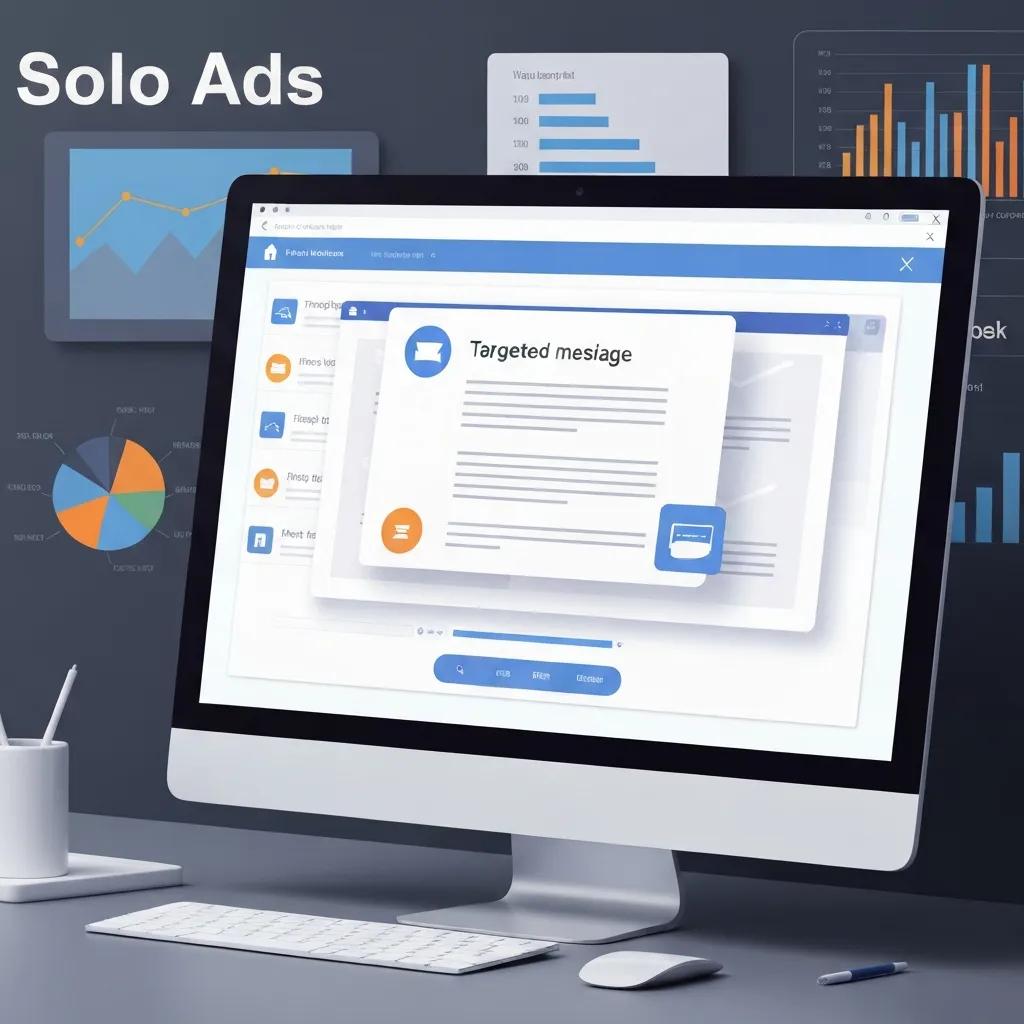
Solo ads are a direct email marketing channel where a list owner sends a dedicated message on behalf of an advertiser to their subscriber base, and Tier 1 solo ads are the same model targeted specifically at high-value geographies. The mechanism is simple: the advertiser provides a tracking link and pre-sell copy, the list owner dispatches the send to a segmented Tier 1 list, and clicks land on a landing page optimized for the offer. This model leverages the list owner’s permissioned audience and, when the audience is Tier 1, produces leads with stronger conversion propensity than generic traffic channels. Understanding the solo ad flow helps you place realistic expectations on response rates and post-click optimizations.
The typical solo ad funnel emphasizes a concise pre-sell, a compelling call to action, and a tightly focused landing page to convert interest into opt-ins or sales. To make the mechanical flow clear, follow these steps that illustrate how a solo ad translates Tier 1 inboxes into measurable campaign actions.
- Prepare: Advertiser creates a tracking link and short, targeted pre-sell email that matches the landing page offer.
- Send: List owner dispatches a dedicated email to a Tier 1 segmented list and reports clicks via the tracking link.
- Convert: Clicks arrive at the landing page, opt-ins are captured, and follow-up emails begin to monetize the lead.
These steps show why segmentation, matching, and timing matter in solo ad buys because each stage affects the ultimate conversion yield from Tier 1 audiences. For buyers seeking Tier 1 solo ad delivery, vendor transparency and list owner targeting are decisive factors.
What are solo ads and how do they utilize Tier 1 traffic?
Solo ads are a paid placement in an email list where a single advertiser’s message occupies the email; list owners charge to send that message to subscribers who have opted into their lists. When scaled for Tier 1 traffic, list owners segment by country and behavior so the send reaches subscribers in high-value geographies, preserving message relevance and purchase potential. The advertiser supplies tracking URLs and often A/B tests subject lines or pre-sell copy to optimize open and click rates. Because the list owner controls segmentation, buying Tier 1 solo ads requires confirming geo filters and delivery guarantees before purchase.
How does Tier 1 solo ad traffic deliver responsive and profitable leads?
Tier 1 solo ad traffic tends to deliver responsive leads because subscribers in Tier 1 geos are both more likely to engage and to follow through with purchase actions when the offer matches their interests. Response rates from Tier 1 lists are often higher for offers priced appropriately to the market, and careful pre-sell content raises email-to-landing conversion. Key tactics to improve profitability include testing subject lines, aligning the landing page message to the email, and ensuring the post-click experience is optimized for speed and clarity. These optimizations compound with the inherent quality of Tier 1 traffic to produce profitable funnels more consistently than lower-tier alternatives.
What is the Difference Between Tier 1, Tier 2, and Tier 3 Traffic?
Traffic tiers are a shorthand for the relative economic and conversion quality of audiences by geography: Tier 1 represents the highest purchasing power and conversion propensity, Tier 2 includes middle-income markets with moderate conversion rates, and Tier 3 covers lower-income or emerging markets with lower average conversion. The key trade-offs are cost versus conversion: Tier 1 typically costs more per click but delivers higher conversion rates that can justify the spend for many affiliate offers. When choosing a tier, align the offer price, affiliate payout, and margin expectations with the expected conversion rates for the chosen geos.
To clarify differences quickly, the table below compares the three tiers across cost, conversion potential, and typical use cases.
| Tier | Cost | Conversion Potential | Typical Use Case |
|---|---|---|---|
| Tier 1 | High | High | High-ticket offers, validated funnels, scaling profitable campaigns |
| Tier 2 | Moderate | Moderate | Mid-ticket offers, testing with moderate budget |
| Tier 3 | Low | Low | Volume traffic, low-cost offers, broad awareness campaigns |
This comparison shows that Tier 1 is preferable when margin supports higher acquisition costs, while Tier 2 and Tier 3 can be tactical for testing or volume at lower budgets.
How do Tier 1 and Tier 2 traffic differ in quality, cost, and conversion potential?
Tier 1 traffic generally commands higher CPMs and CPCs because advertisers compete for audiences with greater purchasing power, resulting in higher conversion potential for suitable offers. Tier 2 markets sit between Tier 1 and Tier 3: costs are lower but so too is conversion predictability, which can make optimization marginal for certain offers. The decision to use Tier 1 over Tier 2 should be driven by offer economics—if your expected payout and lifetime value cover the higher acquisition cost, Tier 1 is often the better long-term play. Measurement discipline—tracking CPA and LTV—is essential to justify the tier selection.
When should affiliate marketers choose Tier 1 traffic over other tiers?
Choose Tier 1 when your offer price, affiliate payout, or expected customer lifetime value can absorb higher acquisition costs and you need reliable conversion data to scale. Also pick Tier 1 when running campaigns for verticals that perform better in mature markets (finance, high-ticket software, premium subscriptions). If you are budget-constrained or validating creative at sub-dollar bids, Tier 2 or Tier 3 can be used for early-stage testing, but successful scale typically moves profitable funnels into Tier 1 geos. Always run controlled A/B tests and measure CPA before fully committing budget to any tier.
How Does Wholesale Premium Traffic Ensure High-Quality Tier 1 Traffic?
Wholesale Premium Traffic specializes in Tier 1 solo ads for affiliate marketers and deliberately positions its primary offering around Quality Tier 1 Traffic solo ad packages that target top geos. The company emphasizes several buyer protections and operational features designed to reduce fraud risk and provide transparent delivery data, which aligns with what performance advertisers need to trust a solo ad vendor. Below is a compact table that outlines the company’s claims, what they mean, and the buyer benefit to make evaluation straightforward.
The following EAV-style table summarizes Wholesale Premium Traffic’s core features and direct buyer benefits for quick reference.
| Feature | What it Means | Buyer Benefit |
|---|---|---|
| 100 percent real human traffic | Sends validated, human clicks rather than bot or simulated traffic | More reliable conversion metrics and actionable data |
| Bot-free delivery | Proactive filtering and list hygiene to exclude bot sources | Reduces wasted spend and false-positive clicks |
| Risk-free guarantee for click delivery | Refund or replacement policy if agreed click delivery isn’t met | Lowers buyer risk when testing campaigns |
| Live tracking | Real-time reporting on sends and clicks via tracking links | Immediate verification and faster optimization cycles |
| Tier 1 geos (US, Canada, UK, Europe, Australia, NZ) | Targeted geographic delivery to high-value markets | Higher conversion propensity for many affiliate offers |
What guarantees and tracking features does Wholesale Premium Traffic offer?
Wholesale Premium Traffic provides a set of guarantees intended to protect buyers: they state “100 percent real human traffic” and “bot-free delivery,” plus a “risk-free guarantee for click delivery” and “live tracking” so buyers can verify performance during delivery. These features mean advertisers can monitor sends in real time and request remediation if delivery metrics do not match the agreed volume. For marketers, these guarantees reduce the common uncertainties of solo ad buys and enable faster, evidence-based decisions about scaling or pivoting campaigns. When evaluating vendors, insist on exact delivery terms and a documented process for claiming replacements or refunds.
Which Tier 1 solo ad packages are available and how to buy them?
Wholesale Premium Traffic markets “Quality Tier 1 Traffic” solo ad packages that focus on top geos like the United States, Canada, United Kingdom, parts of Europe, Australia, and New Zealand; these packages are designed for affiliate marketers who need human, geo-targeted clicks with live tracking. The typical buying flow is straightforward: choose the appropriate Tier 1 package for your geo and list size, provide the tracking link and pre-sell copy, monitor delivery via the live tracking dashboard during the send, and review the post-send report for opt-ins and clicks. Best-practice selection advice is to match package size to your offer’s payout and testing budget—start modestly to validate before scaling—and to prioritize packages with clear click guarantees and live tracking so you can verify the delivery claims.
How Can You Maximize ROI with Tier 1 Solo Ads?
Maximizing ROI with Tier 1 solo ads requires aligning an optimized landing page and a high-converting email follow-up sequence with the initial solo send, while measuring the right KPIs at each stage to guide scale decisions. The principle is to treat the solo ad as an inbox-driven traffic source and to optimize both the pre-sell and post-click experience to suit Tier 1 buyer expectations. Below are practical landing page and follow-up strategies that reliably improve conversion outcomes when applied consistently.
The next list presents landing page best-practices tailored for Tier 1 audiences and solo ad traffic.
- Clear above-the-fold value: Communicate the offer’s primary benefit in a single, focused headline and subheadline.
- Fast page load: Optimize images and server responses so Tier 1 users don’t abandon due to delays.
- Short, focused forms: Ask only for essential data to reduce friction for opt-ins.
- Trust signals: Use concise social proof and payment or privacy reassurance relevant to Tier 1 buyers.
- Mobile-first layout: Ensure forms and CTAs are easy to use on phones and tablets.
- Strong single CTA: Avoid multiple competing CTAs that dilute conversions.
What landing page optimizations increase Tier 1 solo ad conversions?
Landing pages that resonate with Tier 1 traffic focus on fast load times, a single clear value proposition, and trust signals that reflect the expectations of mature markets. Reducing form length and offering social proof tailored to Tier 1 audiences (short testimonials, count metrics, or recognizable badges) lowers friction and increases conversion probability. A/B test headline variations and CTA language while tracking micro-conversions (clicks to form, form starts) to identify friction points. These iterative experiments, combined with reliable Tier 1 traffic, rapidly reveal which elements drive the most lift.
How to use email follow-up sequences to boost Tier 1 traffic results?
An effective email follow-up sequence for Tier 1 leads converts initial opt-ins into buyers by delivering value, social proof, and urgency over a short, measured cadence. A recommended 5-email sequence includes a welcome email that reaffirms the offer, a value/benefit message, a social-proof or case example, a scarcity or deadline prompt, and a final CTA with a clear next step. Timing matters: send the welcome immediately, follow up within 24–48 hours for the second and third emails, and introduce urgency in days 4–7 to push undecided leads toward action. These sequences compound the initial solo ad exposure and often produce the majority of revenue from a single campaign.
Wholesale Premium Traffic’s delivery assurances—100 percent real human traffic, bot-free delivery, a risk-free guarantee for click delivery, and live tracking—can shorten your validation window and give you confidence when using these optimization tactics.
Explore Wholesale Premium Traffic’s Quality Tier 1 Traffic solo ad packages to align reliable Tier 1 delivery with the landing page and follow-up strategies above; their guarantees and live tracking are designed to make optimization decisions faster and less risky.
For campaign planning and buying, combine careful offer-to-geo matching, disciplined measurement, and vendor protections to scale Tier 1 solo ad funnels with confidence.
The final step is action: choose a suitable Tier 1 package size, prepare a tight pre-sell and landing page, and use live tracking and the vendor’s click guarantee to verify delivery before scaling.
Explore Wholesale Premium Traffic’s Quality Tier 1 Traffic solo ad packages and take advantage of the documented guarantees—100 percent real human traffic, bot-free delivery, risk-free guarantee for click delivery, and live tracking—to reduce buying risk and accelerate profitable scaling.